
When a Reporter Gets It Wrong — How to Respond the Right Way
You’ve done your interview, you hit all of your talking points, and now you are waiting for the story to go live.
When it is finally published you see that what has been written is not what you said at all!
Few things can make a public relations professional’s heart sink faster than seeing a misquote or major error in a client’s published piece. Correcting inaccurate media coverage can be tricky, but it’s not impossible. The key is to respond calmly, strategically, and without burning bridges.
Let’s walk through how to do just that.
Step 1: Assess the Damage
Before firing off a heated email, take a breath and ask yourself: “Is this worth fighting?” If the error is minor and won’t affect your client’s reputation, it might be best to let it slide. Sometimes trying to correct a small mistake only draws more attention to it. But if the error is significant — something that misrepresents your client’s stance, misquotes critical data, or creates reputational risk — it’s time to act.
Step 2: Go to the Source, Respectfully
Reach out privately to the reporter with a polite, concise note. Something like: “Thanks for covering our story. I wanted to let you know there are a couple of factual errors in the article and would appreciate the opportunity to set the record straight.” If the reporter doesn’t respond, contact their editor. Keep it professional and courteous. Explain that you tried to resolve it directly with the reporter and include only the facts — no finger-pointing or emotion. Corrections are typically small and placed at the end of the article or in a separate corrections section. They won’t rewrite the piece, but the record will be set straight.
Step 3: Use a Letter to the Editor or Op-Ed
If the error was especially damaging, consider submitting a letter to the editor or an op-ed from a senior leader in your organization. This approach works best when the inaccuracy is major and needs more explanation than a quick correction. Keep the tone professional and objective. Focus on clarifying the facts, not attacking the journalist or outlet. Your goal is to correct the record, not escalate the conflict.
Step 4: Use Owned Media — Only as a Last Resort
If all else fails, use your own channels — your website, blog, or social media — to share a clear, professional correction. For example: “To clarify a story that recently ran in [Outlet Name], here are the correct facts…” Avoid naming or shaming the reporter. Keep it factual, not emotional. Remember, you’re showing your commitment to accuracy, not picking a fight.
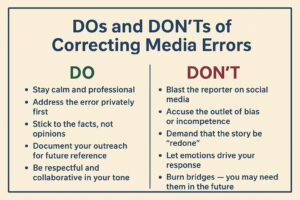
Here are some Dos and Don’ts of Correcting Media Errors
DO:
- Stay calm and professional
- Address the error privately first
- Stick to the facts, not opinions
- Document your outreach for future reference
- Be respectful and collaborative in your tone
DON’T:
- Blast the reporter on social media
- Accuse the outlet of bias or incompetence
- Demand that the story be “redone”
- Let emotions drive your response
- Burn bridges — you may need them in the future
Misreporting happens — even with the best journalists. Your goal isn’t to win a battle; it’s to correct the record and maintain a positive working relationship with the press. Handle it with grace and professionalism, and you’ll not only protect your reputation — you’ll build trust with reporter for the long run.